Moduli of Curves IV: Getting classy
Young tableaux are to planes as labeled trees are to curves. Continuing from the previous post in this series, we introduce the Chow ring of $\overline{M}_{0,n}$ and some important classes.
Recall that in the first post, we answered the question “How many cubic curves in $\mathbb{P}^3$ pass through $5$ general points and are tangent to a given general plane at each of two of the points?” The answer was $2$, and the key to answering questions such as these is to work in the Chow ring of the moduli space.
Roughly speaking, the Chow ring will consist of equivalence classes of subvarieties of the moduli space, and give us ways to answer generic intersection problems. In the above problem, the closed subvarieties in consideration will be the set of all curves passing through the 5 points and tangent to just one of the planes, which corresponds to the psi classes $\psi_1$ and $\psi_2$. Then, multiplying classes in the Chow ring corresponds to intersections of (appropriately chosen representatives of) the corresponding subvarieties, and we have turned our intersection problem into a multiplication problem in a ring.
Read on below…
The Chow ring and intersection theory
Note: Much of this background is better said here, but I’ll summarize here for completeness.
The Chow ring $A^\ast(X)$, for a smooth algebraic variety $X$, is the ring of equivalence classes of cycles of $X$ up to rational equivalence. It is constructed as follows: Let $Z(X)$ be the group of cycles of $X$, consisting of formal linear combinations $\sum_i a_i Z_i$ of closed subvarieties $Z_i\subseteq X$. We mod out $Z(X)$ by the subgroup $R(X)$ generated by cycles of rational functions $f$, written as a sum of their zero loci and poles with orders of vanishing as coefficients. This forms the Chow group $A(X)$, which has a natural grading by codimension as well, written $A(X)=\bigoplus_i A^i(X)$ where $A^i(X)$ is the group of formal linear combinations of cycles of codimension $i$, up to rational equivalence.
For the ring structure to be well defined, $X$ must be smooth, which is why we need to work in the compactification $\overline{M}_{0,n}$ instead of the interior. On a smooth variety, we have a multiplication of equivalence classes given as follows: If $[Y]$ and $[Z]$ are equivalence classes of closed subvarieties $Y,Z\subseteq X$ and $Y$ and $Z$ intersect transversely, meaning roughly that their tangent spaces at intersection points have no overlap, then: \[ [Y]\cdot [Z] = [Y\cap Z]\]
Some fun facts about the Chow ring:
-
On a connected variety X, all points are rationally equivalent to one another, so there is always a class $[pt]$ called the “class of a point”, and it lies in $A^n(X)$ where $X$ has dimension $n$. In fact, all dimension $0$ cycles are sums of points, and so $[pt]$ generates $A^n(X)$.
-
The class $[X]$ lies in $A^0(X)$ and is the “unit” of the ring.
-
If classes $c$ and $d$ are in $A^{i}(X)$ and $A^{j}(X)$ respectively, then $cd\in A^{i+j}(X)$.
Divisor classes and boundary strata
The Chow ring $A^\ast(\overline{M}_{0,n})$ turns out to be generated in degree 1, meaning algebraically generated by elements of $A^1(X)$. These elements are the classes of the codimension $1$ subvarieties corresponding to the boundary strata whose dual tree has a single internal edge, such as the tree below:
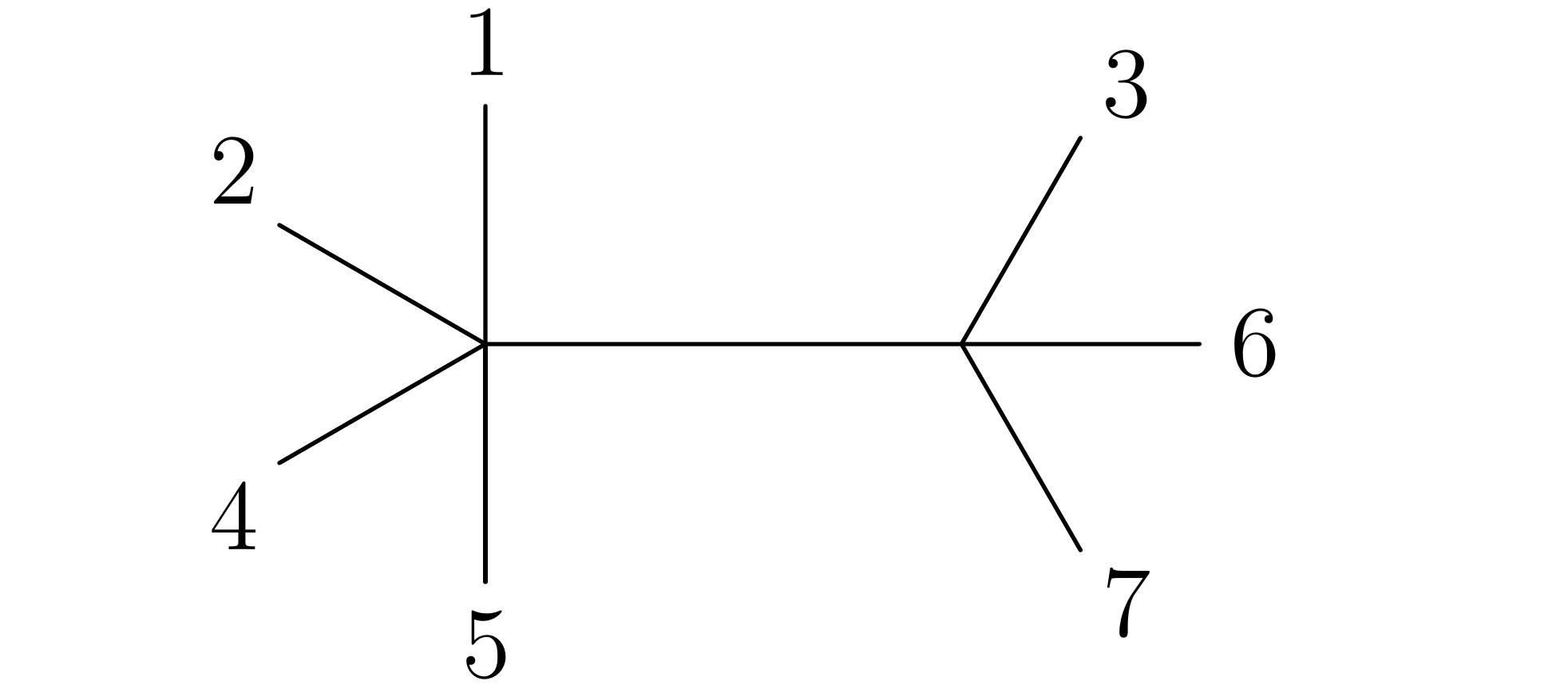
We also write this divisor class as $D(1245)$ for short, and note that we can also write it in many equivalent ways, such as $D(367)$, $D(1425)$, or $D(673)$.
Note that on $\overline{M}_{0,4}$, we have three distinct dual trees with a single internal edge:
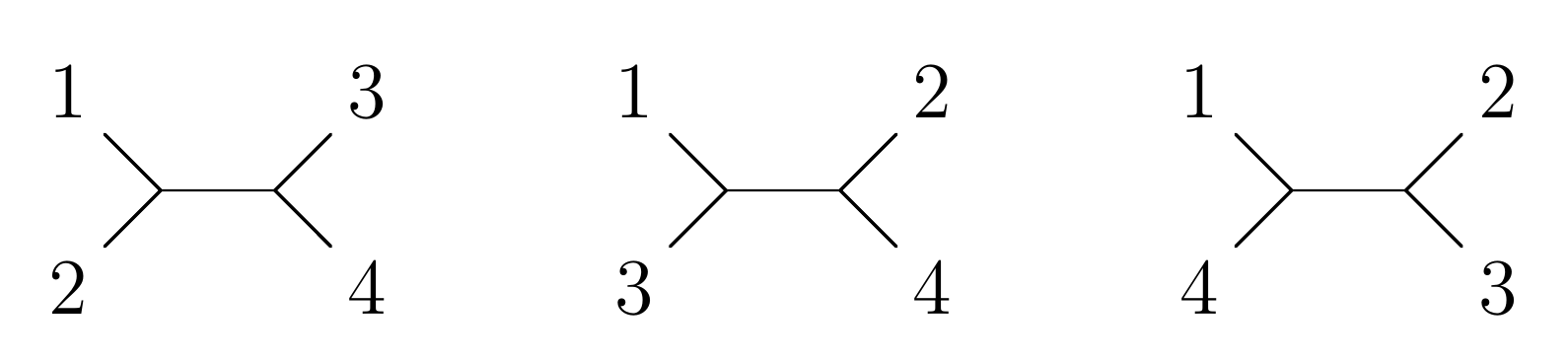
and yet all of these strata consist of a single boundary point of $\overline{M}_{0,4}$. Thus they are all the same class, $[pt]$, and lie in $A^1(\overline{M}_{0,4})$. Notice also that $[pt]\cdot [pt]=0$ because there are in general no intersections between two general points in any given space, and so we have a full presentation of the Chow ring as \[\mathbb{Z}[x]/(x^2)\] where $x=[pt]$. This is essentially equivalent to the computation of the Chow ring of $\mathbb{P}^1$, and indeed we have $\overline{M}_{0,4}\cong \mathbb{P}^1$.
In general we can talk about the class of any boundary stratum in the Chow ring, corresponding to the closure of the set of curves having any fixed dual tree $T$. Each of these can be thought of as a product of an appropriate choice of boundary divisors, one for each internal edge of the tree. For instance, the stratum given by the tree:
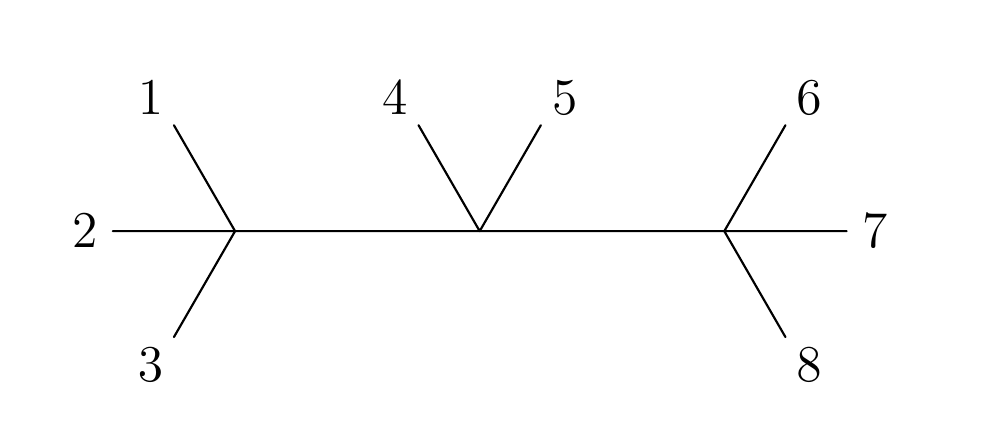
is the intersection of the divisors $D(12345)$ and $D(123)$.
Pushforward and pullback
We now have stated the generators for our Chow ring, but what about the relations? To define them, we need the notion of pullbacks of Chow classes.
Definition. Given a map $f:X\to Y$, where $X$ and $Y$ are spaces with well-defined Chow rings, the pullback is the map \[f^\ast : A^\ast(Y)\to A^\ast(X)\] given by \[f^\ast([Z])=[f^{-1}(Z)]\] for any closed subvariety $Z$ such that $f^{-1}(Z)$ is generically reduced and $\mathrm{codim}_X(f^{-1}(Z))=\mathrm{codim}_Y(Z)$.
The pullback is a well-defined ring map and is a very helpful way of gaining information about the Chow ring of one space from that of another.
Pushforward is trickier to define (and is not always well defined - it is only defined for proper morphisms), and is not a full ring homomorphism, but gives group homomorphisms between the Chow groups:
Definition. For a proper map $f:X\to Y$ where $n=\dim(X)$ and $m=\dim(Y)$, the pushforward is the additive group homomorphism $f_\ast : A^{n-k}(X) \to A^{m-k}(Y)$ for any $k$ (i.e. between Chow groups generated by subvarieties of the same dimension $k$) given by \[ f_\ast([Z])=\begin{cases} \left(\deg{f|_Z}\right)[f(Z)] & \dim(Z)=\dim(f(Z)) \\ 0 & \text{otherwise} \end{cases}.\]
In other words, if the dimension of $Z$ falls under the map, the pushforward vanishes; otherwise it corresponds to the image $f(Z)$ (recording the degree of the map in the coefficient).
Finally, we can state the “WDVV relations”, as derived by Keel for $\overline{M}_{0,n}$ in this paper. Keel showed that $A^\ast(\overline{M}_{0,n})$ is generated by the divisor classes $D(S)$ (for $S\subseteq \{1,2,\ldots,n\}$), subject to the following relations:
- $D(S)=D(S^c)$ for all $S$, where $S^c$ denotes set complement
- $D(S)D(T)=0$ unless $S\subseteq T$, $T\subseteq S$, $S\subseteq T^c$, or $T^c\subseteq S$
- All pullbacks under all possible combinations of forgetting maps to a copy of $\overline{M}_{0,4}$ of the relations $D(12)=D(13)=D(14)$.
As an example, for $\overline{M}_{0,4}$, the three generators $D(12), D(13), D(14)$ are all identified by the relations in the quotient, and since $D(12)D(13)=0$ we have $D(12)^2=0$. Thus $A^\ast(\overline{M}_{0,4})$ is generated by $D(12)$ modulo the relation $D(12)^2=0$, and so the Chow ring is isomorphic to \[Z[x]/(x^2)\] which - as it should - matches the Chow ring of $\mathbb{P}^1$.
For $\overline{M}_{0,5}$ the computation is somewhat more complicated: there are $10$ generators $D(12), D(13), D(14), D(15), D(123), D(124), D(125), D(134), D(135), D(145)$ and many relations, including relations that are the pullback of $D(12)=D(13)$ from forgetting $5$, or the pullback of $D(25)=D(24)$ under forgetting $1$, and so on. The latter gives the relation $D(25)+D(125)=D(24)+D(124)$, for instance, and we end up with many relations. As a fun exercise, one can eliminate variables one at a time using these relations to eventually find that $A^1(\overline{M}_{0,5})$ is isomorphic to $\mathbb{Z}^5$, with only $5$ independent generators, and this corresponds to the fact we will discuss in a later post that $\overline{M}_{0,5}$ is the blowup of $\mathbb{P}^2$ at four points.
Psi classes
We finally can define the psi classes, which capture tangent information at the marked points. One way to define the class $\psi_n\in A^\ast(\overline{M}_{0,n})$ is as the pullback of a hyperplane class $H$ from $\mathbb{P}^{n-3}$ under the Kapranov map $\Psi_n:\overline{M}_{0,n} \to \mathbb{P}^{n-3}$. In other words, the class $\psi_n$ is defined as $\Psi_n^*H$. Here we are using capital $\Psi$ for the map to distinguish it from the class.
Concretely, recall that the Kapranov map can be defined as follows: given a stable curve $C$ in $\overline{M}_{0,n}$, focus on the $\mathbb{P}^1$ component containing the marked point $n$ and coordinatize so that the $n$ is at $\infty$ and the branch containing $1$ is at $0$. Then $\psi_n:\overline{M}_{0,n}\to \mathbb{P}^{n-3}$ by \[C\mapsto (x_2:x_3:\cdots : x_{n-1})\] where $(x_i:1)$ is the coordinate at which the branch containing $i$ is attached. Now, consider the hyperplane $H$ given by the locus of points on which $x_2=0$. The pullback of $H$ under this map consists of the curves on which marked point $2$ is at coordinate $0$, that is, it is on the same branch as marked point $1$. This is the same as saying that $n$ is separated from $1,2$ by a node, which gives that the psi class is the sum of the boundary divisors that have $n$ on a different component than $1$ and $2$. For instance:
\[\psi_6=D(12)+D(123)+D(124)+D(125)+D(1234)+D(1235)+D(1245)\]
on $\overline{M}_{0,6}$.
In general, we define $\psi_i$ to be the sum of divisors separating $i$ from $j,k$ for some $j,k\neq i$. Note that by the WDVV relations, it does not matter what we choose as $j,k$.
We now compute $\psi_1\psi_2$ on $\overline{M}_{0,5}$, which is a translation of the original problem (question 2) in this post that asked how many curves in $\mathbb{P}^3$ pass through 5 given general points and are tangent to a plane at each of two of the points? We can write: \[\psi_1 = D(14)+D(15)+D(145)\] \[\psi_2 = D(12)+D(25)+D(125)\] where in the first equation we are separating $1$ from $2,3$, and in the second we are separating $2$ from $3,4$. Then when we mutiply the two equations together, by Keel’s rule for multiplying divisor classes, most cross terms are $0$ except for: \[\psi_1\psi_2=D(14)D(25)+D(15)D(125)=[pt]+[pt]=2[pt]\] as desired!
In general, there are easier ways to multiply $\psi$ classes by divisor classes or other boundary strata as well; for instance, if we multiply the boundary stratum below at left:
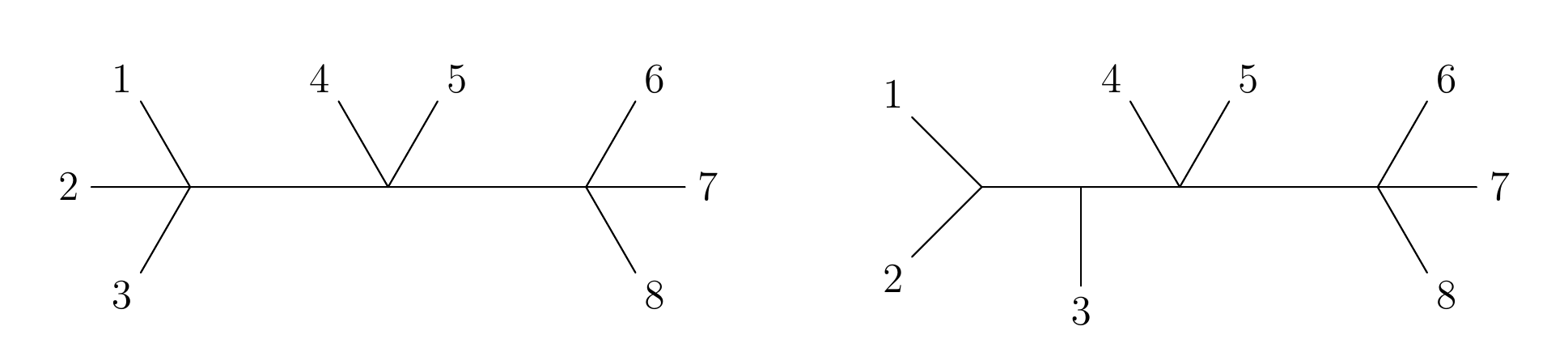
by $\psi_3$, we can think of it as writing down a $\psi$ class on the component containing $3$, where the entire branch containing $4,5,6,7,8$ is counted as one “marked point” that we can choose as $j$ or $k$ to separate from the $3$. If we separate the $3$ from $1,2$ instead, we get the single boundary stratum above at right.
This makes it easy to compute any product of $\psi$ classes by expanding the first as a sum of boundary divisors and then multiplying the rest by each term. We’ll see even easier methods in later posts - stay tuned!